
We all know that health care costs are climbing at an alarming rate, consuming a share of our Gross Domestic Product that simply cannot be sustained. Businesses are struggling to afford the cost of employee health insurance, the number of personal bankruptcies attributable to medical expenses is at record levels and mounting, and virtually every branch of government is trying to come to terms with employee benefit costs that are breaking their budgets.
Add to that the rising number of Americans who have no health insurance and instead have to forego treatment or avail themselves of hospital emergency rooms for even the most routine care, and you have a recipe for disaster.
Obama is correct in demanding that our nation reform its health care system. It’s become an enormous black hole, sucking in every available resource. And yet despite this overwhelming spending, the success at treating patients in this country lags far behind other nations that spend a mere fraction of what we do.
A real key to successful health care reform is making certain that everyone is covered. Yes, even those who believe they don’t need health insurance.
I realize that there are many who object to any laws that would force people to have health insurance. Yet virtually every state, including New Hampshire, has laws that require drivers to carry liability insurance. Admittedly, New Hampshire is a rarity, in that it doesn’t mandate that all drivers carry liability insurance. It limits the requirement to certain classes of drivers, including those who’ve been convicted of D.U.I.’s or other significant moving violations. The vast majority of states, however, insist that all drivers be insured and offer proof of insurance whenever stopped by a law enforcement official.
Moreover, every bank and/or lender requires collision insurance on any vehicle being financed. And in case you haven’t noticed, every mortgage lender requires homeowner insurance as well. From worker’s compensation insurance, to product liability insurance and even malpractice insurance, there are all sorts of insurance mandates with which individuals and businesses already comply.
Another key to successfully reforming our health care system is introducing competition. In New Hampshire there are essentially three insurance providers that cover over 90-percent of employer-based benefits. WellPoint (Anthem-Blue Cross) alone has 51 percent of the market, with Cigna and Harvard Pilgrim capturing the rest. The same scenario exists throughout the country, with only a handful of companies dominating the field.
Obama wants to offer a public option that would strengthen the competitive field and subsequently bring down costs. Naturally, the insurance companies are fighting competition. None of them are anxious to end the gravy train they’ve been enjoying.
Now, many fear government involvement in health insurance. Yet nearly all of our seniors are enrolled in Medicare, which is a government sponsored health insurance program that produces exceptional results. And many of our poor and disabled are enrolled in the government supported Medicaid program, though because of funding issues its success has been more marginal.
Add to that the Veteran’s Hospitals, the military’s health care system, and SCHIP, which covers children, and you’ve already got major government involvement in providing health insurance and health care services. It isn’t as if the government hasn’t produced a viable track record in providing health care for its citizens.
Ironically, many people express concern that health care reform will require dealing with government bureaucrats who will come between them and their doctors. Has anyone not dealt with insurance company bureaucrats? Talk about a staff trained to look for loopholes to deny coverage!
Another concern frequently heard is that government will ration health care, leaving the aged and infirm to die. Come on, people. The whole point of Medicare and Medicaid is to prevent that from occurring.
But yes, some constraints will be placed on spending, just as is true with private insurance companies which always cap the benefits they offer. Unnecessary tests that serve only to inflate the bottom line of providers will be eliminated, as will the prescription of some patented medications for which generic brands offer the same benefits at a much lower cost.
Call it rationing if you must, but from my perspective it’s good financial management. We should not be providing Cadillac coverage as part of a public program when a Chevrolet plan will achieve the same objectives, albeit without the same level of luxury. If people want a more luxurious plan, they can pay for it out of pocket.
That’s precisely what occurs now in our private health care plans. WellPoint offers several different levels of coverage, with premiums that reflect the costs of the benefits. And several insurers offer supplemental coverage above and beyond what Medicare covers. Nothing in Obama’s proposals seeks to curtail those options.
What Obama’s plan is attempting to achieve is ensuring that all Americans have access to basic coverage at a cost that doesn’t break the bank. A public option, that affords more competition in the marketplace, is a key to its success.
My advice is to learn the details of the various plans working their way through Congress, and to the president’s vision for the future of the health care industry. Oh, and don’t be motivated by fear, nor unduly influenced by those who have a vested interest in maintaining the status quo.
We know the current system is seriously flawed. Now is the time to change it while we still have a chance.
Showing posts with label health care. Show all posts
Showing posts with label health care. Show all posts
Tuesday, August 11, 2009


Thursday, June 11, 2009
Time To Pay Up!
(This column was first published in the Laconia Daily Sun on June 3, 2009)
Two times over the past three years I’ve been admitted as an inpatient at Lakes Region General Hospital. The care I received during those stays was extraordinary, as was the subsequent outpatient care extended. The dedicated professionals, from the nurses and physicians, to the technicians, surgeons, pharmacy workers, and orderlies, as well as the administrative staff and the incredibly devoted volunteers, have earned my gratitude and esteem.
Like the thousands of others who have come to rely upon LRGH and its ancillary operations and practices, I realize just how fortunate we are to have this resource available in our community. Yet, its very survival is at risk due to inadequate funding, a perennial problem that is being exacerbated by the state’s fiscal crisis.
Over the past few years I’ve written extensively about the challenges facing LRGHealthcare, which serves an aging population, a marketplace where fewer employers are able to afford to provide health insurance coverage, and rising costs that simply are not being offset by increases in revenue. At issue is our willingness to pay for the costs of services being delivered.
Currently, our local health care providers are struggling to accommodate an alarming expansion in the number of patients dependent upon Medicaid and Medicare, the two primary government insurance programs designed to ensure that the poor and the elderly receive basic health care services. It’s alarming because neither Medicare nor Medicaid come close to reimbursing the hospital nor doctors for their costs of treating insured patients.
Instead, costs are shifted to private insurers and to those few who pay cash out of their own pockets. It’s that cost shifting that has helped fuel the rise in private insurance premiums.
Tragically, with the state facing a budget meltdown, the stage is set for Medicaid and Medicare reimbursement rates to be lowered even further. According to Henry Lipman, LRGHealthcare Vice President and Chief Financial Officer, the proposed cuts will trim over $3-million annually from the non-profit’s revenues.
Add to those losses the increased demand for charitable care as more and more people lose their jobs along with their health insurance, and it’s abundantly clear that LRGHealthcare and its providers are facing an economic tsunami.
State budget writers are taking the heat for the proposed cuts in state health care spending, accused of being irresponsible at best, and heartless at worst. But the fact remains that the legislature can only appropriate expenditures that can be covered by revenue, and New Hampshire is looking at what may be a $500-million shortfall in revenue over the next two years.
What I find so troubling about this is our tendency to blame lawmakers for the problem. It isn’t those we’ve elected to represent us who should be affixed with the blame. It is all of us.
As a state, we’ve come to expect something for nothing. We demand that government serve our needs, yet we balk when we’re presented with the bill. Admittedly, all of us cringe a bit when our PSNH bill arrives in the mail each month, and you can count me among those who deride the cable company for its predictable annual increases. Yet I’ve not once suggested that I shouldn’t pay the bill, realizing that the failure to do so would result in a prompt termination of services.
When government sends out its bill for the services it provides to its constituents, however, the complaints are deafening in their intensity, drowning out any reasonable discussion. People have come to embrace the notion that “government is bad”, forgetting that in a representative democracy, they are the government.
As much as we hate to admit it, our state and local governments run fairly efficient and cost effective operations in delivering the services demanded by the public. No, they’re not perfect. But then, I know few individuals who don’t waste a portion of their income, and government workers are individuals.
The fiscal problems facing New Hampshire have most assuredly been exacerbated by the overall economic decline. But there is undeniably a systemic problem that has plagued the Granite State for years that is rooted in the refusal by the state’s residents to pay for the services they demand. The New Hampshire way is to try to get others to pay the bill for them, whether it be local governments targeting Concord, the state targeting Washington, and everyone trying to entice folks from Massachusetts into paying our bills.
Grow up, and pay up New Hampshire. Otherwise, you’re going to find that government, just like PSNH and Metrocast, is going to terminate service. And that will likely mean that LRGHealthcare will be unable to respond with appropriate quality care when your life depends upon it.
(Ron Tunning is a former newspaper editor and is currently chair of the Laconia Democratic Committee.)
Saturday, December 6, 2008
Bleak Employment Numbers Indicate Recession Is Worsening
With nearly 2 million jobs lost so far this year the prospect for any kind of economic recovery is bleak. Consumer demand for goods and services has plunged, corporate investment has tanked, the housing market is in a shambles, and automakers have been humbled into begging taxpayers for a bailout.
From the New York Times:
Significantly, the loss of jobs has affected men, more than women, due largely to the heavy concentration of women in the healthcare field, education, and other social services.
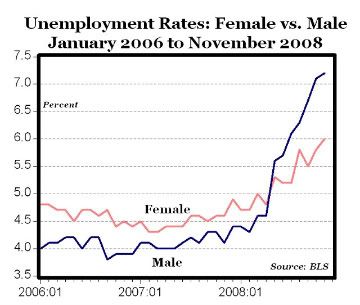
From economist Dr. Mark Perry:
President-elect Obama's desire to provide economic stimulus by investing heavily in infrastructure should provide a boost to employment in the construction and manufacturing sectors. In addition, it's been reported that he wants to provide some relief to states in the form of increased Medicaid funding and education funding, which would likely aid women.
From the New York Times:
Workers Give Up
By David Leonhardt
How bad was today’s jobs report? The unemployment rate rose to 6.7 percent, its highest level since 1993 — and that understated the weakness in the labor market.
According to the Labor Department, the number of unemployed workers rose by 251,000 in November. But the number of people who were outside of the labor force — that is, neither working nor looking for work — rose by much more: 637,000. These people aren’t counted as unemployed in the government’s statistics, because they are not looking for work. Many of them, presumably, have stopped looking for work because they didn’t think they could find a good job. ...continue reading
Significantly, the loss of jobs has affected men, more than women, due largely to the heavy concentration of women in the healthcare field, education, and other social services.

From economist Dr. Mark Perry:
According to today's BLS report, the U.S. economy has lost 2.352 million jobs in the last year (Nov. 2007 to Nov. 2008). Further analysis shows that 82% of the job losses (1.932 million) were jobs held by males, and only 18% of jobs losses (430,000) were jobs held by females (see top chart above). Further, the November unemployment rate for men is 7.2% vs. only 6% for women, and the gap in jobless rates between men and women has been increasing for the last six months (see bottom chart above).
What's going on?
According to this May 2008 BusinessWeek article:
Men have the misfortune of being concentrated in the two sectors that are doing the worst: manufacturing (70% male) and construction (88% male). Women are concentrated in sectors that are still growing, such as education and health care (77% female). ...continue reading
President-elect Obama's desire to provide economic stimulus by investing heavily in infrastructure should provide a boost to employment in the construction and manufacturing sectors. In addition, it's been reported that he wants to provide some relief to states in the form of increased Medicaid funding and education funding, which would likely aid women.
Monday, September 29, 2008
Making A Choice
I’ve heard from many people commenting on how nasty and negative the Shaheen-Sununu race has become, and I concur that it's really despicable. You'd think both of these candidates are evil incarnate. Allow me to offer my opinion.
John Sununu is a decent man who simply is on the wrong side of the issues. He favors big business, has a long record of opposing corporate and financial regulation, and has consistently voted against legislation that would benefit working families, from an increase in minimum wage to an expansion of health care coverage. He's been unwavering in his support of George Bush, including Bush's horrific foreign policy and his devastating fiscal irresponsibility that has buried us in an oppressive $10 trillion debt. John simply does not reflect New Hampshire's values.
Jeanne Shaheen performed admirably as governor for three terms, working with Democrats and Republicans alike. She's a moderate voice in a nation and a state where too often the extremists are most vocal. I disagree with Jeanne on capital punishment, and I believe she missed an opportunity to change New Hampshire's unfair system of taxation that places an extreme burden on working families. But I also know that she embraces New Hampshire's values, from protecting the environment to expanding access to affordable healthcare, and from improving our children's educational opportunities to strengthening the Granite State's economy. She brings an incredible amount of common sense to the table, and offers a breadth of experience that will prove invaluable to New Hampshire in the U.S. Senate.
Let's not lose sight of the fact that all of our major candidates are decent people and do not deserve the abuse being heaped upon them. This even includes John McCain, for whom I’ve lost nearly all respect since he launched his campaign of lies and distortions, and abandoned all principles of integrity. While today he is but a hollow shell of the John McCain who earned the admiration of millions, one cannot discount his past contributions to his country, nor question his patriotism no matter how misguided he may be today.
I truly hope that voters will not be swayed by the extreme messages with which they’re incessantly being bombarded and will instead choose a candidate based upon his or her positions on the issues.
We are today confronted by serious challenges, from a crumbling financial system and a plunging economy, to global terrorism and two mismanaged wars. We’re being held hostage by our reliance upon foreign oil, and we’re despoiling our environment by neglecting the need for serious investment in alternative sources of energy.
Our infrastructure is crumbling, our health care system is in crisis, and our system of public education is in peril. Gratefully, New Hampshire and the nation are equipped to confront these challenges, possessing the resiliency and the creativity needed as we move forward.
What is clear is that we cannot afford to continue along the course we’ve been following for the past eight years. We cannot endure another decade of war and neglect or of allowing unbridled greed to sap the underlying strength of our economy and put at risk our savings, investments, pensions, and even the value of our homes.
Our state and our nation are at a precipice. How we vote this year will determine whether we plunge into an abyss of despair or leap to new heights of achievement. A vote for Republicans is a vote to “stay the course” - to continue on the path we’ve been following.
By contrast, a vote for Democrats will ensure a change of course. That doesn’t mean it will be an easy ride, nor that every trail embarked upon will lead to success. But what it does mean is that we’ll be free to explore new avenues, to navigate the future with confidence in our potential rather than retreating into the paralysis of fear.
When choosing a candidate this year the first question you should ask yourself is that posed by Ronald Reagan in 1980 - “Are you better off than you were four years ago?” The second question you should ask is “Is the country better off than it was eight years ago?”
If you can answer yes to both of those questions, you should vote Republican. Otherwise, the decision is clear.
Subscribe to:
Posts (Atom)